Provenance and confidence
Compass keeps evidence quality visible. A graph is more useful when you can distinguish a relation copied from direct syntax from one resolved across files…
Provenance and confidence
Compass keeps evidence quality visible. A graph is more useful when you can distinguish a relation copied from direct syntax from one resolved across files or left ambiguous.
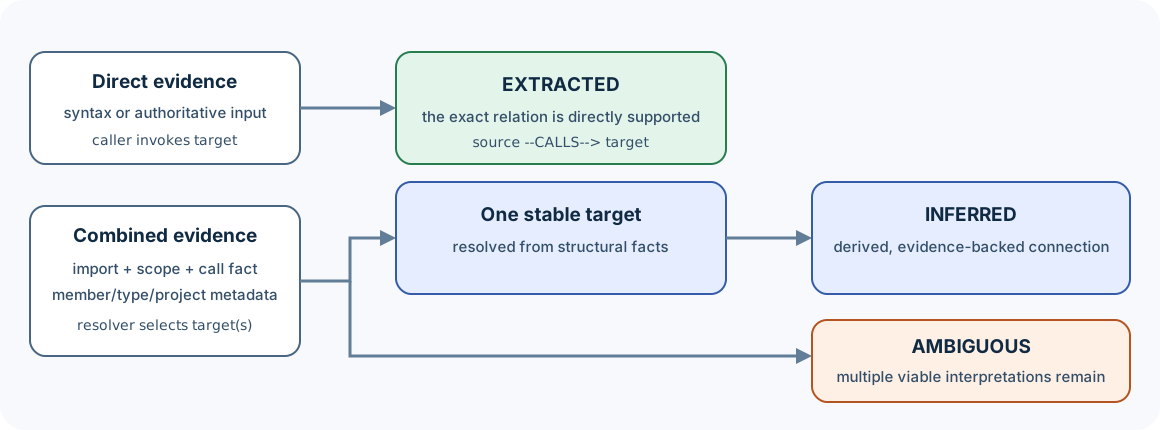
Provenance answers “how do we know?”
Suppose Compass contains:
CheckoutHandler --CALLS--> authorize_payment()The relation alone says what connects the nodes. Provenance says how Compass arrived at that connection.
relation type: calls
provenance:    EXTRACTED
evidence:      direct call syntax and target identity in the same scope
or:
relation type: calls
provenance:    INFERRED
evidence:      imported name + module target + unique matching definition
or:
relation type: calls
provenance:    AMBIGUOUS
evidence:      more than one viable target remained
EXTRACTED
EXTRACTED indicates direct evidence from an extractor or authoritative input.
Examples can include:
- a function syntactically contained in a file;
- an explicit import declaration;
- an inheritance clause naming a base type;
- a call whose target can be identified directly in the extraction scope;
- an explicit relation in an ingested structured source.
It is the strongest statement about evidence locality, but it is not a runtime guarantee.
source says:     class Checkout(PaymentFlow)
graph records:   Checkout --INHERITS [EXTRACTED]--> PaymentFlow
Static evidence can describe unreachable, test-only, platform-specific, or dynamically replaced code.
INFERRED
INFERRED indicates that Compass derived the connection by resolving multiple
facts. Typical resolution evidence includes:
- import source plus exported symbol;
- call name plus scope and unique definition;
- member name plus receiver type or language-specific call facts;
- re-export chains;
- namespace, package, or project metadata;
- a unique placeholder that can be rewired to a real definition.
file A: import { charge } from "./payments"
file A: charge(total)
file B: export function charge(amount) { ... }

resolver:
  import target + exported name + call fact

result:
  checkout() --CALLS [INFERRED]--> payments.charge()
This is structural inference. No semantic model is required for the example.
An inferred edge can be highly reliable when evidence selects one target. The tag remains valuable because a contributor can inspect the resolution rules and because future changes may alter available evidence.
AMBIGUOUS
AMBIGUOUS indicates unresolved alternatives or low-confidence linkage. It
asks the reader to verify before relying on one interpretation.
Common causes include:
- repeated labels without enough scope information;
- dynamic dispatch;
- reflection or dependency injection;
- incomplete build metadata;
- generated code not present in the corpus;
- multiple modules exporting compatible names;
- semantic extraction that cannot select a unique relation.
process()
  |
  +--possible target--> QueueProcessor.process()
  `--possible target--> BatchProcessor.process()

graph evidence:
  AMBIGUOUS until receiver/type evidence selects one
Ambiguity is not a failure to hide. It is useful diagnostic information.
Provenance is not a numeric probability
Do not assign arbitrary probabilities such as:
EXTRACTED = 100%
INFERRED  = 80%
AMBIGUOUS = 30%
Those numbers have no universal meaning across languages, relation types, or repositories. Provenance is a category describing evidence origin and resolution status.
If an integration needs ranking, combine:
- provenance;
- relation type;
- source location availability;
- scope or context;
- uniqueness of the matched identity;
- repository-specific knowledge;
- whether independent graph paths support the same conclusion.
Document that ranking as an application policy, not a Compass truth.
How to review a result
For code navigation
Use EXTRACTED and INFERRED relations freely as navigation leads. Verify the
source before making a consequential edit.
For change impact
Start with both direct and resolved dependency edges. Give ambiguous edges a manual-review bucket rather than dropping them automatically.
For architecture documentation
Prefer repeated, cross-file evidence over a single surprising edge. Use source locations and communities to understand context.
For automated policy
Use exact CompassQL patterns and explicitly state accepted provenance:
MATCH (entry:Function)-[edge:CALLS]->(target:Function)
WHERE target.label = $target
  AND edge.confidence IN ['EXTRACTED', 'INFERRED']
RETURN entry.id, edge.confidence, target.id
If a policy must act only on direct evidence:
MATCH (source)-[edge]->(target)
WHERE edge.confidence = 'EXTRACTED'
RETURN source.id, type(edge), target.id
Remember that attribute presence and naming follow the graph mapping contract.
The CompassQL mapping supplies missing relationship confidence as EXTRACTED
for compatibility.
Provenance and semantic extraction
Semantic sources can add relations that are not program syntax. Their structured output is validated before merge, but interpretation depends on the provider, prompt, mode, and source content.
Do not conflate:
structural INFERRED
    derived by deterministic name/scope/project resolution

semantic relation
    derived through the configured semantic pipeline
Both can live in one graph. Inspect relation attributes and source metadata, and keep semantic build profiles distinct in versioned history.
Provenance through graph operations
Operations that merge, export, diff, or reconstruct graphs should preserve relationship attributes and multiplicity. Dropping confidence on export makes later review less trustworthy.
For historical export:
graph-jsonreconstructs the canonical graph JSON;compass-outalso restores authoritative, non-derivable sidecars and uses recorded renderer versions when regenerating derived outputs.
Semantic equivalence does not require insignificant JSON member ordering, but it does require graph structure, attributes, duplicate id-less hyperedges, and authoritative bytes to remain correct.
Troubleshooting unexpected provenance
| Observation | Investigation |
|---|---|
Expected EXTRACTED, got INFERRED | Check whether target identity required cross-file or member resolution |
Expected unique target, got AMBIGUOUS | Search for duplicate labels, re-exports, missing manifests, or dynamic dispatch |
| Edge disappeared after update | Check whether source, ignore rules, or resolver evidence changed |
| Semantic edge appears in code-only build | Confirm which graph path or historical realization was queried |
| Integration treats missing confidence as unknown | Follow the documented graph/CompassQL compatibility default |
When reporting a suspected extraction bug, include:
- the smallest source fixture that reproduces it;
- the relevant nodes and edge;
- expected relation and provenance;
- actual graph JSON;
- language and project metadata needed for resolution.
Contributor rule of thumb
When adding an extractor or resolver:
Can one input directly justify the exact endpoints?
    yes -> EXTRACTED may be appropriate
    no  -> resolution evidence is required

Does the evidence select one stable target?
    yes -> INFERRED may be appropriate
    no  -> preserve ambiguity; do not guess
Add a fixture that proves direction, multiplicity, attributes, and provenance together. A test that checks only that “some edge exists” is too weak for a public graph contract.
Related pages
Next step: read CompassQL concepts to select and filter evidence precisely.
How Compass works
Compass turns a directory of source code and project artifacts into a directed, queryable knowledge graph. This page explains the complete flow first in…
Set up Compass for a coding assistant
Compass embeds assistant integration assets in its native executable. This guide explains automatic detection, explicit multi-agent selection, scope,…