How Compass works
Compass turns a directory of source code and project artifacts into a directed, queryable knowledge graph. This page explains the complete flow first in…
How Compass works
Compass turns a directory of source code and project artifacts into a directed, queryable knowledge graph. This page explains the complete flow first in plain language, then at the level needed to reason about correctness, performance, and extension points.
The short version
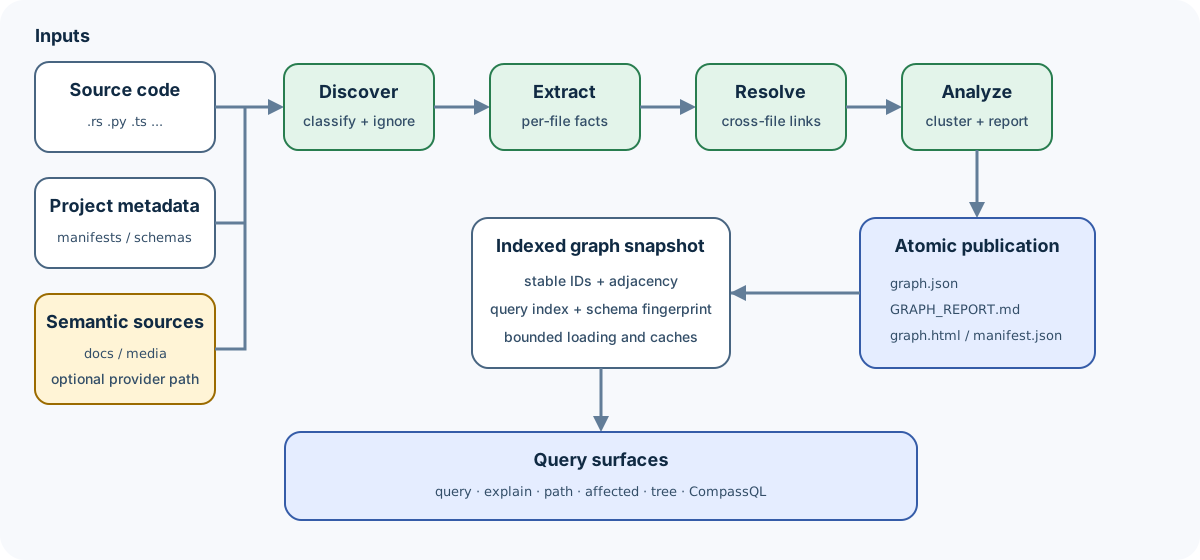
Compass does six things:
1. Discover     choose relevant files and project metadata
2. Extract      turn each source into entities and local relationships
3. Resolve      connect facts that cross files, modules, or languages
4. Analyze      group, rank, and diagnose the resulting graph
5. Publish      write a coherent compass-out/ artifact set
6. Query        load indexes and return focused subgraphs or exact matches
For source code, the first five stages are structural and local. Parsers identify syntax; language-specific extractors turn that syntax into facts; the resolver connects facts across files. No embedding model or vector database is needed.
Documents, images, audio/video, and other semantic sources are different. They may require the model provider or native media capability you explicitly configure. This optional path merges into the same graph rather than creating a separate search index.
A working example
Consider:
from payments import PaymentGateway


def checkout(total):
    gateway = PaymentGateway()
    return gateway.charge(total)
A simplified graph might contain:
app.py
  |
  +--CONTAINS-----------> checkout()
  |
  `--IMPORTS_FROM-------> payments.py

checkout()
  |
  +--USES---------------> PaymentGateway
  |
  `--CALLS--------------> PaymentGateway.charge()
The parser supplies facts such as “this node is a call expression” and “this identifier occurs in this scope.” A language extractor creates file, function, class, import, and call facts. Resolution uses import targets, names, members, and scope information to connect the call to the best known definition.
The graph keeps direction. checkout() --CALLS--> charge() means something
different from the reverse. Query and impact commands can therefore choose
whether to follow outgoing, incoming, or both directions.
Stage 1: discovery
Discovery decides what enters the build. It:
- walks the requested root;
- applies supported extensions and project-file detection;
- respects committed ignore rules by default;
- applies explicit exclusion patterns;
- classifies source code, manifests, documents, media, and integration inputs;
- computes or reuses fingerprints for incremental work.
Discovery is a correctness boundary. A perfect parser cannot represent a file that was excluded, ignored, generated after the scan, or outside the requested root.
Useful questions when something is missing:
Was the file under the requested root?
Was its extension or format recognized?
Did an ignore or exclude rule remove it?
Did the build use code-only mode?
Did an optional integration require explicit configuration?
--no-gitignore changes the ignore behavior and should be used deliberately.
Large generated directories can create noise and cost even when their syntax
is supported.
Stage 2: structural extraction
Compass contains a deterministic language registry and a vendored tree-sitter language pack. At build time, supported languages use native parsers and language-specific extraction rules.
For each file, extraction can produce:
- file and module nodes;
- definitions such as functions, methods, classes, types, variables, and database objects;
- containment and declaration edges;
- import, call, inheritance, use, reference, and configuration relations;
- source file and source location attributes;
- language-specific facts needed by the later resolver;
- hyperedges for facts that naturally involve more than two participants.
Per-file extraction is intentionally separable. Independent files can be parsed in parallel, and unchanged file facts can be reused by an incremental build.
Structural does not mean simplistic. Language-specific code handles concerns such as:
- JavaScript and TypeScript re-exports;
- member calls and inheritance;
- namespaces and packages;
- project manifests;
- templates and markup;
- languages whose build metadata changes name resolution.
It does mean that results are based on parseable project evidence, not semantic similarity.
Stage 3: cross-file resolution
A per-file extractor often cannot know the final target of a relation. The resolver merges file facts and connects them using project-wide evidence.
For example:
file A                        file B
------                        ------
imports payments             defines module payments
calls charge()               defines PaymentGateway.charge()
       \                         /
        \                       /
         +---- resolver -------+
                  |
                  v
      checkout --CALLS--> PaymentGateway.charge
Resolution performs targeted language and project operations, including canonicalizing import targets, following re-exports, resolving call and member facts, disambiguating colliding identifiers, and rewiring unique placeholder nodes to known definitions.
This distinction explains provenance:
- a relation directly present in a file can be EXTRACTED;
- a cross-file relation connected by the resolver can be INFERRED;
- a relation with multiple viable targets can remain AMBIGUOUS.
“Inferred” in this context is not shorthand for “generated by an LLM.” It means Compass derived the link from structural evidence rather than copying one explicit syntax relation.
Stage 4: merge and graph analysis
The merged result is a directed graph document. Analysis derives navigation and diagnostic information such as:
- node degree and highly connected “god nodes”;
- communities of densely related nodes;
- cross-file or cross-community connections;
- suggested questions;
- import cycles and other diagnostics;
- summary data for
GRAPH_REPORT.md.
Communities
A community is a group with stronger internal connectivity than external connectivity according to the clustering algorithm. Communities often resemble features or subsystems, but they are graph-derived—not hand-maintained architecture labels.
Use a community as a starting hypothesis:
community 4 appears to contain:
  auth middleware
  token parsing
  session storage
  login handlers

hypothesis:
  community 4 is the authentication subsystem
Verify the hypothesis by looking at source locations and boundary edges.
God nodes
A god node has unusually high degree. It may be:
- a true architectural hub;
- a broad interface or dispatcher;
- a configuration root;
- a generic type used everywhere;
- a noisy or overly broad extraction target.
Degree identifies connectivity, not quality or business importance. Compass filters common built-in noise in reports, but interpretation still matters.
Stage 5: atomic publication
The normal current-tree output lives in compass-out/. The public artifacts
include:
| Artifact | Responsibility |
|---|---|
graph.json | Strictly valid machine-readable node-link graph |
GRAPH_REPORT.md | Human-readable orientation and diagnostics |
graph.html | Optional interactive visualization |
manifest.json | Incremental build state |
The build pipeline treats output as a set. Invalid individual node and edge records are deterministically quarantined and reported before the remaining graph passes strict validation. A partial graph is published with an explicit warning and exact omission summary. Document-level validation errors or an empty usable graph remain failures and cannot replace the current snapshot. Write paths use temporary or staged artifacts and atomic replacement where the contract requires it.
Compass first commits the authoritative immutable generation. It then
materializes the conventional root-level files with independent atomic
replacement, placing graph.json, graph.html, GRAPH_REPORT.md, and
manifest.json exactly where ordinary file-based integrations expect them.
If that façade publication is interrupted, its completion marker is left
absent and the next build repairs the full set. The generation protocol and
cache encoding can therefore evolve without forcing consumers to follow a
private storage layout.
Consumers should still avoid reading files while a writer is replacing an artifact set. A long-lived integration can either watch for completion, invoke Compass itself, or open a graph snapshot only after the producing command returns successfully.
Stage 6: loading and querying
Read commands resolve compass-out/graph.json by default. When the published
generation has a validated SQLite sidecar, typed code queries use that indexed
snapshot; explicit --engine json forces the portable reader. The graph layer:
- validates the JSON extension and size guard when the portable reader is used;
- decodes the node-link document;
- preserves directed and multigraph semantics;
- indexes stable node IDs;
- builds incoming and outgoing adjacency;
- builds query indexes and a schema fingerprint;
- may reuse a local binary cache when it matches the graph signature.
The main read surfaces answer different questions:
| Command | Question |
|---|---|
query | Which focused neighborhood is relevant to this phrase? |
explain | What is this node and what connects to it? |
path | How are these two entities connected? |
affected | What may depend on this entity through impact relations? |
tree | What hierarchical structure surrounds this entity? |
query --cql | Which rows exactly match this structural pattern? |
Natural-language discovery is still deterministic graph search. It tokenizes the question, scores candidate nodes, and traverses from relevant anchors under a budget. It does not write a prose answer with a model.
CompassQL compiles an explicit structural query into a bounded execution plan. It is the right choice when automation needs exact patterns, parameters, typed JSON, limits, or profiles.
Current tree versus exact Git history
compass update . describes the working tree at build time. That can include
uncommitted changes.
Versioned history answers a different question: “What was the complete graph for this exact Git commit under this exact extraction profile?”
working tree                         exact commit
------------                         ------------
compass update .                     compass history build REV
      |                                       |
      v                                       v
compass-out/                         immutable realization
current mutable artifact set        content-addressed Prolly roots in SQLite
Historical materialization resolves a revision, creates a protected offline worktree, runs the recorded build profile, validates the result, and publishes an immutable realization. Meaning-affecting inputs are captured in an extraction fingerprint so a code-only graph is not silently compared with a semantic graph.
Read Versioned graph history before operating the history store.
Optional semantic path
Some project knowledge is not represented by program syntax:
- design documents;
- ADRs and RFCs;
- prose requirements;
- images and diagrams;
- office documents;
- audio or video;
- remote workspace or database sources.
When enabled, semantic orchestration:
- classifies supported non-code inputs;
- renders or decodes content where needed;
- chunks content under configured limits;
- sends permitted content to the configured provider or native model path;
- validates structured extraction results;
- merges semantic nodes and edges with the structural graph;
- prevents incomplete provider work from masquerading as a complete build.
Credentials and provider/model selection affect meaning and therefore affect a history realization's fingerprint, but secret values are not stored in that fingerprint.
Use --code-only when you need an explicit fully local structural profile.
Compass does not silently downgrade a requested semantic history build because
credentials are missing.
Determinism and limits
Determinism has practical meanings:
- the same supported inputs and meaning-affecting configuration should produce an equivalent structural graph;
- output ordering is stable where the public contract requires it;
- query budgets and resource limits are explicit;
- unsupported CompassQL syntax is rejected, not approximated;
- historical realizations are immutable once published.
It does not mean:
- every filesystem state is stable while being scanned;
- a provider will always return identical semantic content;
- dynamic runtime behavior can always be recovered from static source;
- JSON member ordering is a semantic graph property.
Bounded behavior protects interactive and automated use. Graph loading has a size cap. CompassQL has row, path-depth, relationship-expansion, memory, and deadline limits. File/stdin query sources and parameter documents also have caps. Consult the CompassQL reference for current values.
Failure model
Compass distinguishes categories so scripts can respond correctly:
usage or compile mistake
    -> fix the command/query; retrying unchanged input will not help

graph loading or validation failure
    -> inspect path, JSON, size, endpoints, or artifact completeness

provider or integration failure
    -> check credentials/network/source; incomplete builds do not publish

resource limit or cancellation
    -> narrow the work or lower scope; no successful partial result is emitted

history corruption or profile mismatch
    -> use explicit inspection/rebuild/profile commands; do not overwrite silently
Exact exit codes differ by command family. Use the command reference and canonical CompassQL/history documents for automation.
Related pages
Next step: read Graph model to interpret the entities, relationships, and attributes returned by Compass.
The Compass graph model
Compass stores project knowledge as entities connected by directed, attributed relationships. This page develops the model from a small example to the…
Provenance and confidence
Compass keeps evidence quality visible. A graph is more useful when you can distinguish a relation copied from direct syntax from one resolved across files…